
AI is changing the way people search for information, compare products, and make buying decisions. Instead of typing short keywords into a traditional search engine, users can now have detailed conversations with AI tools, explain what they need, compare different options, and ask follow-up questions. This shift is creating a new opportunity for ChatGPT advertising, where brands can potentially connect with customers while they are actively exploring products, services, and solutions.
This is where Chat GPT Ads Expansion: A New Era of AI Advertising becomes important for digital marketers. Open AI began testing ads in Chat GPT in the United States in February 2026 and has since expanded the program into additional international markets. By August 31, 2026, Open AI reported that Chat GPT Ads had reached a $1 billion annualized revenue run rate in less than 200 days, with tens of thousands of advertisers using the platform. Open AI also said advertisers could purchase Chat GPT ads directly through Ads Manager in India, Europe, the Middle East, and North Africa.
So, what exactly does Chat GPT Ads Expansion: A New Era of AI Advertising mean for businesses? In simple terms, it represents the development of an advertising channel designed around conversations rather than traditional search-result pages. Chat GPT ads can appear separately from Chat GPT’s answers and are clearly identified as advertisements. Open AI says advertising does not influence the answers Chat GPT provides, while conversations remain private from advertisers.
For marketers, the interesting part is user intent. Someone asking ChatGPT, “Which laptop should I buy for video editing?” or “What software is best for a small business?” is already exploring a specific need. ChatGPT advertising gives businesses an opportunity to be visible during these decision-making moments rather than relying only on traditional keyword-based campaigns.
The expansion is also becoming more sophisticated. OpenAI introduced CPC bidding in May 2026 and later added tools such as conversion optimization, geo-targeting, custom audiences, and expanded measurement capabilities.
For digital marketers, ChatGPT Ads Expansion: A New Era of AI Advertising is therefore more than another advertising format. It signals a broader shift toward AI-native marketing, where context, conversation, and user intent can play a larger role.
In the sections ahead, we’ll break down ChatGPT advertising, how ChatGPT ads work, what businesses need to know, potential benefits and challenges, and how marketers can prepare for this emerging advertising channel.
What Is ChatGPT Ads Expansion?
ChatGPT Ads Expansion refers to the rapid development of advertising within ChatGPT, turning conversational AI into a new environment where businesses can reach people while they explore products, compare options, and make decisions. Instead of relying only on traditional search pages, ChatGPT advertising places brands inside an AI-powered experience where users explain their needs in natural language and often provide more context than they would in a short search query.
OpenAI began testing ads in ChatGPT in the United States in February 2026. By August 2026, the program had expanded to more than 40 countries, with tens of thousands of advertisers using the platform. OpenAI also reported that ChatGPT Ads had reached a $1 billion annualized revenue run rate in less than 200 days.
How Does ChatGPT Ads Expansion Work?
The basic idea behind ChatGPT advertising is contextual relevance. Suppose someone asks ChatGPT, “What accounting software is suitable for a small business?” The conversation itself provides information about the user’s intent. ChatGPT’s advertising system can use signals such as the current conversation, the ad’s content and landing page, and—when personalization is enabled—selected signals from the user’s broader ChatGPT experience to determine which eligible ad may be relevant.
Currently, ChatGPT ads are displayed separately from ChatGPT’s answers and are clearly labeled. OpenAI says advertising does not influence the answers ChatGPT provides, and advertisers do not receive access to users’ private conversations.
For businesses, this creates a different type of advertising opportunity. Rather than waiting for a customer to search a specific keyword, brands can potentially appear when that customer is already researching a solution or comparing alternatives. OpenAI has also introduced CPC bidding, conversion optimization, geographic targeting, custom audiences, and additional measurement tools as the platform expands.
Traditional Search Advertising vs. Conversational Advertising
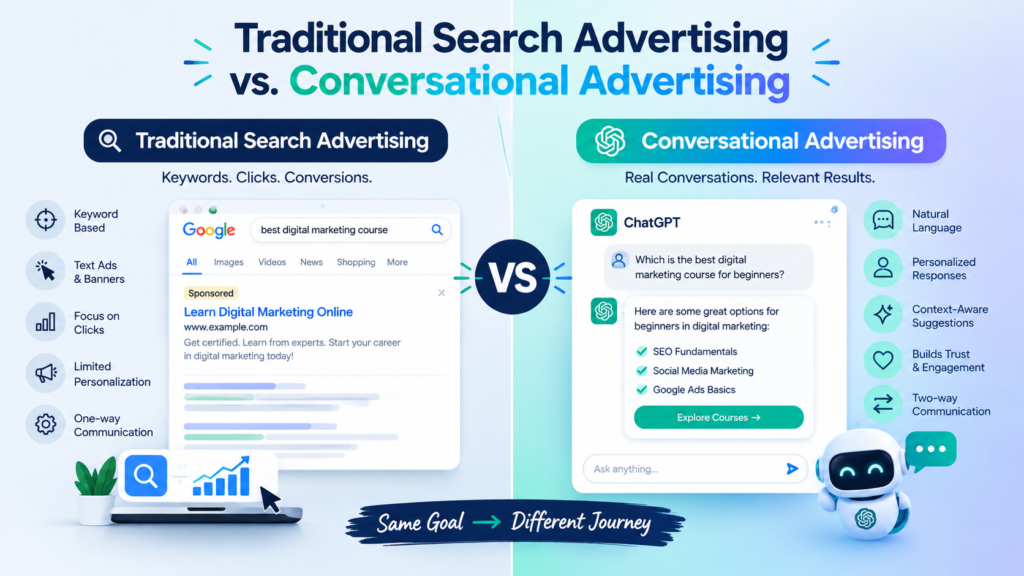
Traditional search advertising generally starts with a keyword. A user enters a query, an advertising system matches eligible ads to that search, and the user chooses which result to explore.
Conversational advertising works differently. A user may describe a problem, provide preferences, ask follow-up questions, and compare several solutions within one conversation. This gives ChatGPT advertising a broader context for matching an ad to a user’s apparent intent. OpenAI describes this model as advertising built around “conversation, context, and real-time decisions.”
For digital marketers, ChatGPT Ads Expansion therefore represents a shift from simply targeting keywords toward understanding the broader context behind a customer’s question. As ChatGPT ads continue to develop, businesses will need to think beyond traditional keyword targeting and focus on clear offers, useful landing pages, strong brand positioning, and genuine customer intent.
What Is ChatGPT Advertising?
ChatGPT advertising is a form of digital advertising designed for the conversational AI environment of ChatGPT. Instead of showing an advertisement only after someone types a traditional search query, this approach allows businesses to reach users while they are exploring ideas, comparing products, evaluating services, or deciding what to do next. OpenAI describes ChatGPT Ads as an advertising environment built around conversation, context, and real-time decisions.
The important difference is context. In traditional advertising, marketers often work with keywords such as “best running shoes” or “digital marketing agency.” In ChatGPT, a user might explain their situation in much greater detail: “I run a small online store and need an affordable tool to manage my marketing.” That conversation can provide richer signals about what the person is trying to accomplish. OpenAI says its ad system considers the context and intent of the current conversation, along with the ad’s content and landing page; where ad personalization is enabled, selected signals from the user’s broader ChatGPT experience may also be considered.
How ChatGPT Advertising Can Change Product Discovery
With ChatGPT advertising, product discovery can become more conversational. A customer does not necessarily have to search through multiple pages of results before finding relevant options. They can ask questions, compare alternatives, identify requirements, and continue the conversation.
For marketers, this creates an opportunity to focus less on simply matching a keyword and more on matching customer intent. OpenAI’s current advertising guidance specifically recommends clear, specific, benefit-focused ad copy rather than generic marketing messages.
The potential business benefits include greater visibility during consideration moments, access to users with clear purchase or research intent, and another channel for driving website visits and conversions. ChatGPT Ads currently support objectives including views, clicks, and conversions, while Ads Manager provides metrics such as impressions, clicks, CTR, CPC, CPM, and conversions.
How AI Responses Differ From Search Results
Traditional search engines generally present a page containing links, advertisements, maps, images, and other results. The user then decides which sources to open and compare.
An AI assistant can instead respond directly to the user’s question and continue the discussion through follow-up prompts. ChatGPT advertising adds a commercial layer to this conversational journey, while keeping advertisements separate from ChatGPT’s answers. OpenAI states that ads are clearly labeled and do not influence the answers ChatGPT generates.
For digital marketers, this means ChatGPT advertising is not simply another place to copy an existing search ad. It requires understanding conversational intent, creating useful messaging, and giving users a clear reason to take the next step. As this advertising model develops, businesses that understand how customers ask questions—not just what keywords they type—will have a new factor to consider in their digital marketing strategy.
What Are ChatGPT Ads?
When people search for ChatGPT ads, they are generally looking for information about paid advertisements that appear within the ChatGPT experience. In simple terms, these are sponsored placements that allow businesses to promote products or services while users are exploring options, comparing alternatives, or making decisions through conversations. OpenAI describes ads as paid placements and makes clear that seeing an ad does not mean OpenAI endorses or recommends the advertiser.
Possible Formats and Placements of ChatGPT Ads
The first advertising format tested by OpenAI was designed to appear at the bottom of a ChatGPT answer when there is a relevant sponsored product or service. OpenAI’s approach is to keep advertisements visually separate from the organic AI response rather than inserting promotional material directly into the answer itself. Ads are also clearly labeled so users can distinguish paid content from ChatGPT’s response.
For advertisers, this creates a different environment from traditional display advertising. Instead of placing a banner randomly across a webpage, ChatGPT ads can be delivered in a conversational environment where people are actively researching a topic or considering an action. OpenAI’s advertising platform currently supports campaign creation, budgeting, bidding, and performance measurement through Ads Manager.
Sponsored Recommendations vs. Organic AI Responses
One important distinction is that a sponsored placement is not the same thing as an organic ChatGPT recommendation. An organic response is generated as part of the conversation, while an advertisement is paid for by an advertiser.
For example, if a user asks ChatGPT to explain different types of running shoes, the AI-generated explanation is part of the normal response. A separately displayed sponsored placement from a shoe company is an advertisement. This distinction matters because users should not assume that a business appearing in an ad has been independently selected by ChatGPT as the best option.
OpenAI states that ads do not influence the answers ChatGPT provides. It also says conversations are kept private from advertisers.
Why Transparency Matters
Transparency is particularly important when advertising appears alongside AI-generated information. Users need to understand what is paid promotion and what is an organic AI response before making purchasing decisions. Clear labels, visual separation, and access to information about why an advertisement was shown can help maintain that distinction.
For digital marketers, this means ChatGPT ads should not be treated simply as another version of traditional search ads. The format sits within a conversational experience, so relevance and clarity become especially important. As ChatGPT advertising develops, maintaining a clear boundary between sponsored content and organic responses will be essential for building user trust while giving businesses a new way to reach potential customers.
What Is a ChatGPT Ad?
A chatgpt ad is essentially a paid advertising placement shown within the ChatGPT experience. For marketers, it represents a shift from advertising around a user’s search query to advertising within a conversational journey. Instead of simply targeting a phrase such as “best CRM software,” a chatgpt ad can be relevant to a broader conversation where a user is explaining a business problem, comparing solutions, or looking for a product.
OpenAI currently describes ChatGPT ads as clearly labeled sponsored content that appears separately from ChatGPT’s organic responses. Ads are not presented as part of the AI-generated answer, and OpenAI says advertisers cannot pay to influence what ChatGPT says in its responses.
How Can an Individual ChatGPT Ad Appear?
Imagine a small-business owner asking ChatGPT: “I need accounting software for my company. I have five employees and want something affordable and easy to use.”
Instead of immediately searching through multiple websites, the user is already communicating their requirements in natural language. A relevant chatgpt ad could appear separately from the response, giving the business an opportunity to present its product to someone who is actively researching a solution.
The key difference is context. Traditional advertising often starts with a keyword, while conversational advertising can consider the subject and intent expressed throughout a conversation. OpenAI says its ad system can use the current conversation’s context and intent, as well as information from the advertiser’s campaign, such as the ad and landing page.
What Information Do Advertisers Need to Provide?
Advertisers need to create campaigns with information that helps communicate what they are offering. Depending on the campaign, this can include the business or product name, ad creative and copy, landing-page URL, targeting settings, budget, bidding strategy, and campaign objective.
OpenAI’s advertising platform supports campaign objectives including views, clicks, and conversions, while advertisers can use performance metrics such as impressions, clicks, CTR, CPC, CPM, and conversions to evaluate campaigns.
Examples Across Different Businesses
For an e-commerce brand, a conversational ad could introduce relevant products when users are researching what to buy.
For a SaaS company, an ad could appear around conversations about software solutions, encouraging users to explore a product or start a trial.
For a local service business, advertising could potentially help introduce its service to people researching solutions in a particular location, subject to available targeting options.
For a digital marketing agency, the opportunity could involve reaching business owners who are actively researching SEO, paid advertising, social media marketing, or website growth.
Ultimately, chatgpt ad represents more than another advertising placement. It is part of the broader movement toward conversational advertising, where understanding customer intent and providing a relevant next step can become just as important as traditional keyword targeting.
How Do Ads in ChatGPT Work?
The basic concept behind ads in ChatGPT is relatively simple: a user starts a conversation, explains what they need, and—when an advertising opportunity is relevant and eligible—a sponsored placement may appear separately from the AI-generated response. This creates a different advertising environment from traditional search because the user’s intent can develop across a conversation rather than being expressed through one short keyword.
User Query → Conversation → Commercial Opportunity
Think of the journey like this:
User query → Conversation → User intent → Relevant advertising opportunity → Sponsored content
For example, a user might ask, “What should I look for when choosing accounting software for a small business?” They may then ask about pricing, features, integrations, or ease of use. These questions provide conversational context around what the user is researching. If an eligible advertiser has a relevant campaign, ads in ChatGPT can potentially be displayed alongside that experience.
OpenAI says its advertising system considers signals such as the current conversation’s context and intent, as well as information from the advertiser’s campaign, including the ad and landing page. If ad personalization is enabled, selected signals from a user’s broader ChatGPT experience may also be used.
How Relevance and User Intent Matter
Relevance is particularly important in conversational advertising. A person discussing “how to start a podcast” has a different commercial intent from someone asking, “Which microphone should I buy for podcasting under $200?”
For marketers, this means ads in ChatGPT can potentially reach users at different stages of the customer journey—from discovering a problem to comparing solutions or preparing to purchase. OpenAI’s advertising platform currently provides campaign objectives such as views, clicks, and conversions, giving advertisers different ways to measure campaign performance.
However, relevance does not mean that an advertisement becomes part of ChatGPT’s answer. OpenAI states that ads are separate from the response and that advertisers cannot pay to influence or alter ChatGPT’s answers.
Advertising vs. Regular ChatGPT Responses
This distinction is one of the most important aspects of ads in ChatGPT.
A regular ChatGPT response is generated as part of the conversation. A sponsored advertisement, on the other hand, is paid promotional content from an advertiser. OpenAI says ads are clearly labeled and visually separated from ChatGPT’s response, helping users identify commercial content.
For example, if ChatGPT explains the factors to consider when selecting a laptop, that explanation is an organic AI response. A separately labeled laptop advertisement shown around that conversation is paid content.
Why User Experience and Transparency Matter
Advertising in an AI conversation needs to feel useful rather than disruptive. If every conversation were filled with unrelated promotions, users could quickly lose trust in the platform and the advertising itself.
That’s why transparency matters. Users should be able to distinguish between ChatGPT’s response and sponsored content, understand that an advertisement is paid promotion, and make purchasing decisions accordingly. OpenAI also states that advertisers do not receive users’ private conversations.
For digital marketers, the lesson is straightforward: successful ads in ChatGPT will likely depend not only on reaching the right audience, but also on relevance, clear messaging, trustworthy landing pages, and respect for the conversational user experience.
How ChatGPT Advertising Could Benefit Businesses
The biggest opportunity with ChatGPT advertising is the ability to connect with people while they are actively thinking through a problem, researching a product, or comparing potential solutions. Unlike traditional advertising, where marketers often target users based on keywords, interests, or demographics, conversational advertising can operate in an environment where the user’s needs are expressed through natural language and ongoing questions.
Reach Users During High-Intent Conversations
Consider a user asking, “Which project management software should I use for a team of 20 people?” That is a much stronger commercial signal than someone casually reading a general article about productivity. If an advertiser offers a relevant solution, ChatGPT advertising can provide an opportunity to introduce that business while the user is actively evaluating options.
OpenAI’s advertising platform currently supports campaign objectives including views, clicks, and conversions. Advertisers can also access metrics such as impressions, clicks, CTR, CPC, CPM, and conversions to evaluate campaign performance.
More Contextual Advertising
Context is one of the most interesting aspects of AI advertising. A traditional search query might contain only a few words, while a ChatGPT conversation can explain the user’s budget, requirements, preferences, and goals.
For example, someone might say, “I run a small online clothing store and need an affordable email marketing platform.” That conversation gives marketers a clearer picture of the problem being researched. OpenAI says its ad system can consider the current conversation’s context and intent when determining relevant advertisements.
New Opportunities for Product Discovery
ChatGPT advertising could also create another path for discovering products and services. Instead of a customer navigating through numerous search results, they can discuss their requirements conversationally and encounter relevant sponsored options within that experience.
For businesses, this can create opportunities across different industries—from SaaS and e-commerce to education, professional services, travel, and local businesses.
Lead Generation and Conversions
For marketers, visibility is only the first step. The real goal is often generating qualified traffic, leads, or sales. OpenAI’s current advertising tools include conversion-focused campaign objectives and measurement capabilities, allowing advertisers to evaluate actions beyond simple impressions.
A software company could promote a free trial, an education provider could encourage course enquiries, while a digital agency could direct interested business owners toward a consultation page.
How Small Businesses and Large Brands Can Approach AI Advertising
Small businesses don’t necessarily need enormous budgets to explore AI advertising. They can start with a specific product, clearly defined audience, focused landing page, and measurable conversion goal. Large brands, meanwhile, can test multiple creative approaches, audience segments, and campaigns while analyzing performance data.
The key for both is the same: don’t simply copy a traditional search advertisement. ChatGPT advertising works within a conversational environment, so businesses should focus on solving a specific customer problem, communicating a clear benefit, and providing a useful next step.
As ChatGPT Ads Expansion: A New Era of AI Advertising continues, businesses have another channel to consider—but the fundamentals of good marketing remain unchanged: unde
ChatGPT Ads vs Traditional Search Ads
Both ChatGPT ads and traditional search ads are designed to connect businesses with potential customers, but the way they reach those users can be quite different. Traditional search advertising is primarily built around keywords and search-result pages, while ChatGPT advertising operates within a conversational environment where users can explain their needs and continue asking questions.
| Factor | ChatGPT Ads | Traditional Search Ads |
| Search keywords | Can use conversational context and intent signals rather than relying only on a short keyword. | Primarily built around keywords, search queries, and keyword targeting. |
| User intent | Intent can develop across multiple messages and questions in a conversation. | Intent is generally interpreted from the user’s search query and related signals. |
| Ad placement | Sponsored ads can appear separately from ChatGPT’s AI-generated response and are clearly labeled. | Ads commonly appear in designated positions on search-engine results pages. |
| Conversational context | A conversation can provide additional context about the user’s requirements, preferences, and goals. | Context is usually centered around the current search and available targeting signals. |
| Personalization | Depending on settings and eligibility, advertising can use contextual signals and selected information from a user’s ChatGPT experience. | Personalization can use factors such as search activity, audience signals, location, interests, and other platform data. |
| User experience | Users interact with an AI assistant and can ask follow-up questions during their research journey. | Users typically scan a results page and choose an advertisement or organic result to visit. |
| Measurement & analytics | ChatGPT’s advertising tools provide metrics including impressions, clicks, CTR, CPC, CPM, and conversions. | Search platforms commonly provide impressions, clicks, CTR, CPC, conversions, conversion value, and other campaign metrics. |
Search Keywords and User Intent
Traditional search advertising starts with a query such as “best CRM for small business.” The advertiser bids on relevant keywords and competes for visibility when those terms are searched.
With ChatGPT ads, the interaction can be much more detailed. A user might explain their business size, budget, required features, and specific problem over several messages. OpenAI says its advertising system considers the context and intent of the current conversation when determining relevant ads.
Placement and Conversational Context
The placement is another major difference. Traditional search ads are displayed within search-result pages, whereas ChatGPT ads are designed to appear separately from the AI-generated response. OpenAI says advertisements are clearly labeled and do not influence ChatGPT’s answers.
This separation is important because users should know whether they are reading an organic AI response or viewing paid promotional content.
Personalization and User Experience
ChatGPT advertising has the potential to make advertising more contextual because the system can understand conversational intent. OpenAI says that, when ad personalization is enabled, selected signals from a user’s broader ChatGPT experience may also be considered.
The user experience is therefore different from scrolling through a traditional search-results page. Users can ask follow-up questions, refine requirements, and continue researching within the same conversation.
Measurement and Analytics
Measurement remains essential regardless of the advertising channel. OpenAI’s current advertising platform supports objectives such as views, clicks, and conversions, with metrics including impressions, CTR, CPC, CPM, and conversions.
For marketers, the practical takeaway is not that one advertising model replaces the other. ChatGPT ads and traditional search advertising represent different environments. Search ads remain focused on query-based discovery, while conversational advertising introduces a model centered more heavily on conversation, context, and evolving user intent.
How Marketers Can Prepare for ChatGPT Advertising
As AI-powered search and discovery continue to develop, marketers need to think beyond traditional search rankings. ChatGPT advertising is creating another potential touchpoint between brands and customers, but businesses should not wait for advertising technology to mature before improving their digital presence. The fundamentals—useful content, strong branding, clear messaging, and measurable goals—still matter.
Strengthen Website Content and SEO
A strong website remains the foundation of digital marketing. Businesses should create helpful, original content that directly answers customer questions instead of publishing pages simply to target keywords.
For example, an SEO agency could create detailed resources around local SEO, technical SEO, Google Business Profile optimization, and common ranking challenges. Clear headings, structured information, FAQs, internal links, and regularly updated content can make a website easier for both people and search technologies to understand.
Create Clear Product and Service Information
When customers discover a business through an AI-powered experience, they need accurate information to evaluate the offer. Make your product or service pages specific about what you provide, who it is for, pricing where appropriate, key features, benefits, limitations, and how customers can get started.
For marketers exploring ChatGPT advertising, this is particularly important because OpenAI says its advertising system can consider information from an advertiser’s ad and landing page when determining relevance.
Focus on Brand Credibility and Authority
AI advertising does not eliminate the need for trust. Businesses should build credibility through genuine customer reviews, case studies, transparent company information, expert content, and consistent branding.
Avoid exaggerated claims that cannot be supported. A strong brand should communicate what it does clearly and provide evidence that helps potential customers make informed decisions.
Understand Conversational Search Behavior
People do not always search using short phrases. They increasingly ask complete questions, explain their situation, and request comparisons.
Instead of targeting only “digital marketing services,” for example, marketers can also create content addressing questions such as “How can a small business generate more leads online?” or “Which digital marketing strategy should a local business start with?”
This conversational approach can help businesses prepare for AI-powered discovery and potential ChatGPT advertising opportunities.
Track Developments in AI Advertising
The AI advertising landscape is changing quickly. OpenAI has introduced capabilities such as CPC bidding, conversion optimization, geo-targeting, custom audiences, and additional measurement tools for ChatGPT advertising campaigns.
Marketers should monitor platform updates rather than relying on outdated assumptions about how AI advertising works.
Adapt Content for AI-Powered Discovery
Finally, create content around customer problems and intent, not just keywords. Build comprehensive service pages, comparison guides, FAQs, tutorials, original research, and useful resources that answer the questions your target audience actually asks.
For marketers, preparing for ChatGPT advertising is ultimately about becoming easier to understand and more useful to potential customers. Whether a person discovers your business through Google, social media, an AI assistant, or a paid advertisement, clear information and genuine value remain the foundation of sustainable digital marketing.
Potential Challenges of ChatGPT Ads
While ChatGPT advertising can create new opportunities for businesses, introducing paid promotions into an AI-powered conversation also creates challenges. Unlike a traditional webpage, ChatGPT is an interactive environment where users expect direct, useful, and trustworthy answers. For advertisers and platforms, the challenge is to generate commercial value without damaging that experience.
Maintaining User Trust
Trust is one of the biggest challenges for ChatGPT ads. People use AI assistants to get answers and recommendations, so they need to understand whether information is organic or paid.
OpenAI says advertisements are separate from ChatGPT’s answers and that advertisers cannot pay to influence what ChatGPT says. Keeping this separation clear is important because users should not assume that a sponsored placement represents ChatGPT’s independent recommendation.
Ad Transparency
Transparency becomes even more important when advertisements appear alongside AI-generated information. Users should be able to recognize promotional content without confusion.
OpenAI says ads are clearly labeled and visually separated from the response. It also provides users with controls to understand why an ad was shown and to manage certain advertising preferences.
For marketers, the lesson is simple: advertisements should communicate clearly that they are promotional rather than attempting to look like organic AI-generated content.
Privacy and Data Considerations
Privacy is another important consideration. Users may share detailed information with an AI assistant during conversations, which makes data handling especially sensitive.
OpenAI states that advertisers do not receive users’ conversations, and advertisers cannot use conversations to build or augment their own profiles of ChatGPT users. OpenAI also says ad targeting can use conversation context and intent, while personalized advertising may use selected signals from a user’s broader ChatGPT experience when personalization is enabled.
For businesses, understanding platform privacy rules should be part of responsible advertising planning.
Avoiding Irrelevant Advertisements
Nobody enjoys seeing an advertisement that has nothing to do with what they are doing. In a conversational environment, irrelevant ads can be particularly noticeable because users expect the system to understand context.
For ChatGPT advertising to be useful, advertisers need clear messaging, accurate landing pages, and well-defined targeting. OpenAI’s advertising guidance emphasizes relevance and recommends that advertisers use specific, benefit-focused messaging.
Measuring Advertising Performance
Another challenge is determining whether an advertisement actually contributes to business results. Impressions and clicks can show visibility and engagement, but marketers ultimately need to understand whether campaigns generate meaningful actions.
OpenAI’s advertising platform provides metrics such as impressions, clicks, CTR, CPC, CPM, and conversions, with campaign objectives that include views, clicks, and conversions.
Marketers should therefore define the desired outcome before launching a campaign and measure performance against that goal.
Balancing Monetization With User Experience
Finally, platforms must balance advertising revenue with the experience users expect from an AI assistant. Too many promotions could make conversations feel commercial rather than helpful.
This is where ChatGPT ads need a different mindset from traditional display advertising. Relevance, clear labeling, useful landing pages, and appropriate frequency can all contribute to a better experience.
For digital marketers, the opportunity is significant, but responsible ChatGPT advertising will require more than simply placing an ad in front of an audience. The long-term success of AI advertising will depend on maintaining trust, protecting privacy, providing relevant promotions, and ensuring that monetization does not overwhelm the value users come to ChatGPT to receive.
The Future of ChatGPT Ads Expansion
The future of ChatGPT Ads Expansion is moving beyond simply placing a sponsored message below an AI response. As conversational AI becomes part of how people research products, compare services, and make decisions, advertising can become more interactive and connected to the customer’s journey.
OpenAI’s advertising platform is still in beta, but its development has been rapid. By August 2026, OpenAI said ChatGPT Ads had reached a $1 billion annualized revenue run rate in less than 200 days, with tens of thousands of advertisers using the platform. It also reported that Ads were available in more than 40 countries.
How Conversational Advertising Could Evolve
One major development is the possibility of making advertisements more interactive. In September 2026, OpenAI announced testing of Sponsored Agents, which allow users to start a conversation with a business-sponsored agent after clicking an advertisement. OpenAI also introduced AI-powered creative tools and integrations with HubSpot and Shopify.
This points toward a model where an advertisement may become the beginning of a conversation rather than the end of one. Instead of clicking an ad, visiting a landing page, and searching for information independently, a customer could potentially interact directly with a sponsored business experience.
Potential Impact on Search Engine Marketing
The growth of ChatGPT advertising could influence how marketers think about search. Traditional search marketing is largely built around keywords, rankings, bidding, and search-result pages. Conversational AI introduces another environment where users can explain their needs in greater detail.
That does not mean traditional search advertising disappears. Instead, marketers may need to manage multiple discovery channels: search engines for keyword-driven intent, social platforms for discovery and engagement, and AI assistants for conversational research and decision-making.
The shift could also encourage marketers to focus more heavily on intent and context rather than individual keywords. OpenAI’s current advertising system already considers conversation context and intent when selecting eligible ads.
Opportunities for Brands and Digital Marketers
For brands, ChatGPT Ads Expansion creates opportunities to become visible during moments when customers are actively evaluating their options. E-commerce companies, SaaS brands, educational businesses, agencies, and service providers can potentially use conversational advertising to introduce their offers to relevant audiences.
For digital marketers, this means developing new skills around conversational intent, AI-friendly content, landing-page optimization, conversion tracking, and AI advertising analytics. OpenAI already supports conversion-focused campaigns and measurement through tools such as its Pixel and Conversions API.
The Role of AI in the Future of Online Advertising
AI is likely to influence more than ad placement. It can help businesses create advertising copy, develop creative concepts, analyze campaign performance, identify relevant audiences, and optimize campaigns toward business outcomes.
At the same time, marketers should remember that ChatGPT Ads Expansion is still an evolving platform. OpenAI’s own FAQ says ChatGPT Ads remains in beta and that there are not yet established performance benchmarks across advertisers, industries, or campaign types.
For marketers, the future is therefore less about abandoning traditional advertising and more about adapting to a broader digital ecosystem. ChatGPT advertising adds another potential channel where conversation, context, and real-time intent can influence how brands connect with customers.
As AI continues to reshape online discovery, the marketers who focus on useful information, strong brand positioning, relevant offers, and measurable outcomes will be better prepared to adapt as conversational advertising develops.
Frequently Asked Questions About ChatGPT Ads
What are ChatGPT ads?
ChatGPT ads are paid advertising placements that appear within the ChatGPT experience. They are displayed separately from ChatGPT’s regular AI-generated responses and are clearly labeled as sponsored content. Currently, ads can appear below ChatGPT responses for eligible users, while OpenAI’s advertising system uses signals such as conversation context, intent, ad content, and landing-page information to determine relevant placements.
Is ChatGPT going to have ads?
Yes. ChatGPT Ads are already being tested and expanded in 2026. OpenAI began testing ads in the U.S. in February 2026 and has since expanded the program to additional markets. As of August 31, 2026, OpenAI said ChatGPT Ads were available to advertisers across India, Europe, the Middle East, and North Africa through Ads Manager.
Ads may appear for eligible Free and Go users. OpenAI currently says Plus, Pro, Business, Enterprise, and Edu accounts do not have ads.
How could ads in ChatGPT work?
Ads in ChatGPT work around the context of a user’s conversation. For example, someone researching accounting software could potentially see a relevant sponsored advertisement from a software company.
OpenAI’s advertising system considers signals including the current conversation’s context and intent, the advertisement’s title and copy, landing page, advertiser-provided context hints, and certain targeting selections. When personalized ads are enabled, selected signals from a user’s broader ChatGPT experience may also be used.
Importantly, advertisements are separate from ChatGPT’s answers. OpenAI says advertisers cannot pay to influence, rank, or alter the AI’s responses.
What is ChatGPT advertising?
ChatGPT advertising is a form of digital advertising designed specifically for a conversational AI environment. Instead of relying only on traditional keyword-based searches, advertisers can reach users while they are exploring, comparing, and making decisions within a conversation.
For advertisers, the platform currently supports objectives such as Views, Clicks, and Conversions, along with measurement of impressions, clicks, CTR, CPC, CPM, and conversions.
How could ChatGPT ads affect digital marketing?
ChatGPT ads could introduce another important channel for product discovery and customer acquisition. Traditional search advertising is largely centered around keywords and search-result pages, while conversational advertising can use broader context and intent.
For digital marketers, this means creating content and advertising campaigns that address real customer problems rather than focusing exclusively on individual keywords. Businesses may also need to pay greater attention to conversational search behavior, landing-page quality, clear messaging, and conversion tracking.
However, ChatGPT Ads is still in beta, and OpenAI says there are not yet established performance benchmarks across industries, advertisers, or campaign types. Results can vary depending on factors such as creative, relevance, landing-page experience, campaign objective, and setup.
Can businesses advertise through ChatGPT?
Yes. Eligible businesses can advertise through ChatGPT Ads Manager in supported countries and regions. Advertisers can create campaigns, set objectives and budgets, choose targeting options, create ads, and measure performance through Ads Manager Beta.
OpenAI currently supports campaign objectives including views, clicks, and conversions. Conversion-focused campaigns can optimize toward supported actions such as purchases, sign-ups, and lead submissions.
For businesses considering this channel, the practical starting point is the same as with any advertising platform: define a clear business objective, understand the target audience, create relevant messaging, use a strong landing page, and measure actual business outcomes rather than focusing only on impressions or clicks.
Conclusion
Summarize what ChatGPT Ads Expansion means.
Recap how ChatGPT advertising, ChatGPT ads, and ads in ChatGPT could affect digital marketing.
End with a forward-looking statement about AI and advertising.
Suggested SEO Keyword Placement
| Keyword | Recommended placement |
| ChatGPT Ads Expansion | H1, introduction, conclusion |
| ChatGPT advertising | H2 + body content |
| ChatGPT ads | H2 + body content |
| chatgpt ad | H2 + body content |
| ads in ChatGPT | H2 + body content |
| AI advertising | Body + supporting keywords |
| conversational advertising | Body + supporting keywords |
| AI marketing | Body + conclusion |